

 English
 Français
 Deutsch
 Italiano
 Português
 Русский
 Español
 简体中文
简体中文 日本語
日本語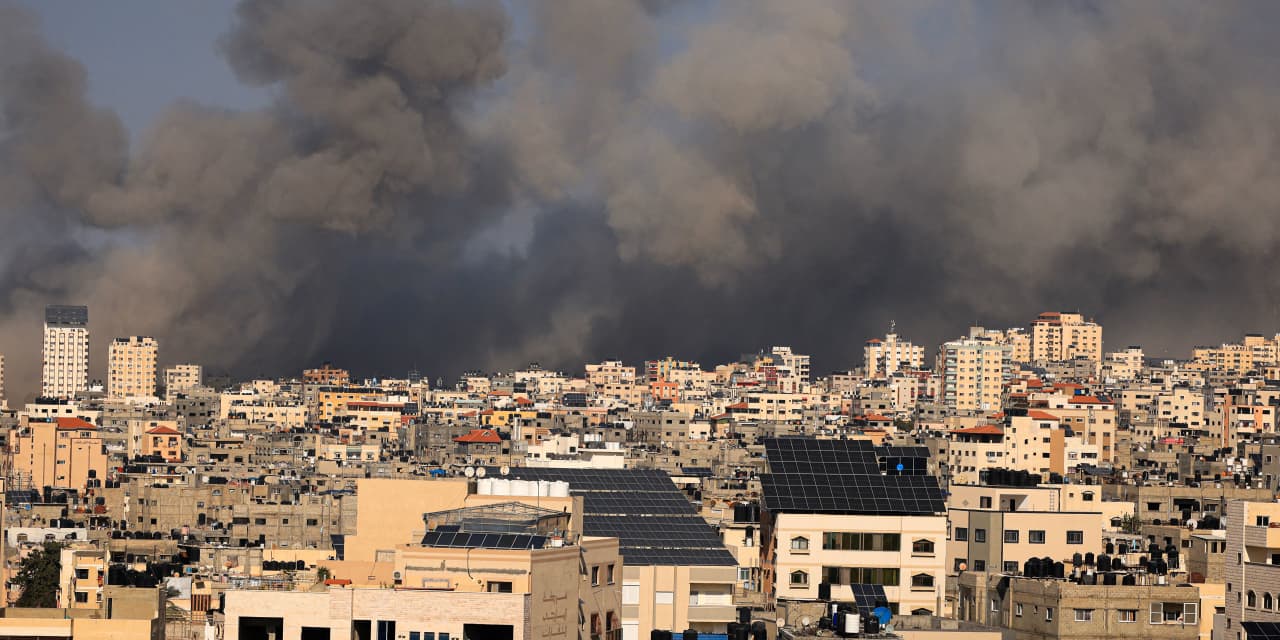

Oil prices continued to rise on Friday as worries over the escalation of war in the Middle East—a critical region for crude supply—continued with Israel poised for a ground invasion of Gaza in the wake of the unprecedented attack by Hamas terrorists last weekend.
Continuous-contract futures for U.S. oil benchmark West Texas Intermediate gained 4.5% to above $86.50 a barrel on Friday, up from below $83 at the end of last week, before terror group Hamas struck Israel in the worst attack on the country in decades.
The move higher in crude has also lifted shares in oil producers.
Exxon Mobil
(ticker: XOM) stock gained 1.4% in premarket trading on Friday, with shares in
Chevron
(CVX) up 1.4% as well.
Occidental Petroleum
(OXY) advanced 2.1% and
TotalEnergies
(TTE) was 1.8% higher.
While WTI remains below a yearly peak above $93 seen last month, the price of a barrel of crude has still risen some 14% higher in recent months
“That’s quickly becoming another headache for policy makers,” said Sophie Lund-Yates, an analyst at broker Hargreaves Lansdown.
Indeed, the rising cost of energy since a summer trough has been a renewed upward force on inflation, keeping persistent pressure on price-growth. It could complicate the Federal Reserve’s job of controlling inflation with higher interest rates, and threatens to rattle investor hopes that the central bank has already raised borrowing costs to their peak.
“Geopolitical situations such as these can change direction at short notice and have the ability to rattle markets and energy prices in a big way,” said Lund-Yates. “Investors are wary of the unknown so this is keeping a lid on market performance until a clearer trajectory toward peace is found.”
Analysts have eyed two key risks for crude against the backdrop of Middle Eastern conflict. The first is the prospect that the war could draw in Iran, a major oil producer that The Wall Street Journal reported played a role in planning Hamas’ rocket barrage and incursion into Israeli territory.
The second is that escalating violence—with more than a thousand Israelis killed and the civilian casualty count rising in Gaza, under fire from Israeli bombing—could disturb a U.S.-led deal to normalize relations between Israel and Saudi Arabia. The kingdom is a critical player in global energy markets, and a possible normalization deal reportedly includes a promise to increase oil production.
The latest from the conflict is that an Israeli ground invasion of Gaza looks likely. Hamas rejected an Israeli order for more than one million Palestinian residents to evacuate northern Gaza ahead of an expected invasion of the territory.
Write to Jack Denton at [email protected]
Read the full article here