


 English
 Français
 Deutsch
 Italiano
 Português
 Русский
 Español
 简体中文
简体中文 日本語
日本語

Company logo
I started a long position in Neumora Therapeutics, Inc. (NASDAQ:NMRA) last week with a 4.2% portfolio allocation. This recent central nervous system (“CNS”) disease IPO is using technologies like machine learning, genomics and proteomics to target common CNS diseases like major depression, schizophrenia, and Parkinson’s disease using novel mechanisms of action.
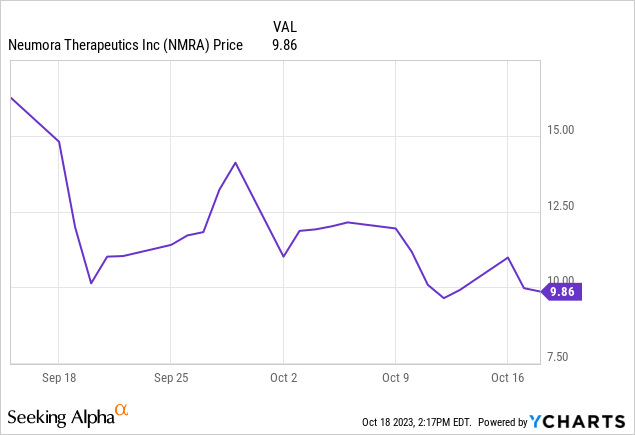
The stock has fallen below its IPO price of $17 and is rebounding back. I assign a high probability of success in the upcoming KOASTEL-1 data in major depression in 2H 2024. My price target on Neumora Therapeutics, Inc. stock is $31 (280% upside), 2-5 years timeframe based on discounted cash flow (“DCF”) valuation.
Investment Thesis
This is a Boston-based CNS diseases company. Early investors include blue-chip institutions like Amgen (AMGN), Softbank, Arch Ventures, Polaris Ventures, etc., who invested over $600 million in the company.
The lead product candidate is Navacaprent, a selective kappa opioid receptor, KOR antagonist in treating major depressive disorder, MDD, a condition that affects 280 million people worldwide, and 21 million people in the U.S. a. The KOR/dynorphin system has been known to modulate depression, anhedonia, and anxiety. It has a novel mechanism of action in MDD, with advantages like high potency, and safety, rapid onset of action. According to KOLs interviewed by the company, the drug also has the potential for benefit in anxiety and cognitive impairment.
Phase 2a data in MDD showed a significant improvement in MDD symptoms as measured by HAMD-17 score at four weeks and eight weeks, HAMD-17. An important benefit of this drug is the improvement in anhedonia (as measured by SHAPS total score, p<0.001) in the Phase 2a trial. Anhedonia is a lack of interest, enjoyment, or pleasure from life’s experiences, and is seen in 70% of MDD patients. From a safety point of view, it was well tolerated.
Phase 2a data for Navacaprant in major depressive disorder (Investor presentation)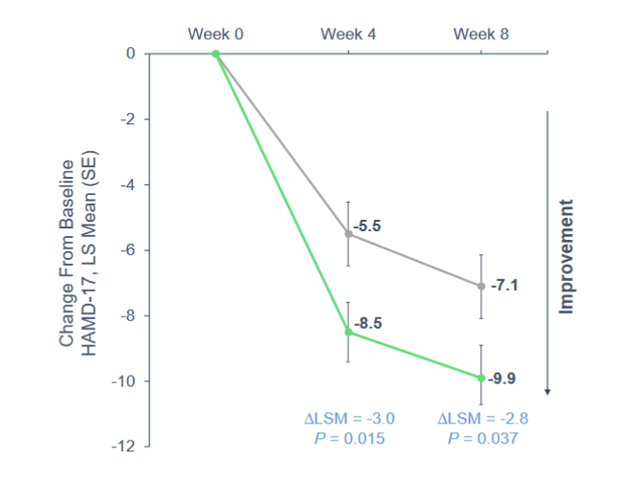
HAMD-17 is also the primary endpoint in the ongoing Phase 3 trial, KOASTEL-1, which has a randomized, placebo-controlled design and eight weeks duration (same as Phase 2a). Phase 2a p-value at eight weeks was 0.037 (<0.05 is significant). Phase 3 has a higher number of patients and is more powered to show significant clinical benefit.
Phase 3 program for Navacaprant in major depressive disorder (Investor presentation)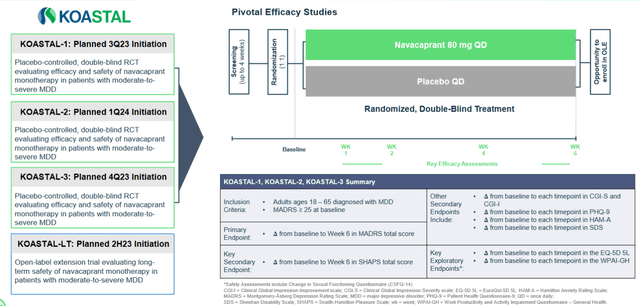
In addition to MDD, Navacaprant also has the potential to improve depression and anhedonia symptoms in bipolar depression, a condition that affects 80 million people worldwide and 12 million people in the U.S. The proof-of-concept in this condition was shown in the Phase 2 MDD study and NIMH-sponsored FASTMAS study. A Phase 2, randomized, placebo-controlled trial is ongoing, and data is expected next year.
Other value-driving product candidates include:
– NMRA-511, V1aR antagonist, which is being tested in a Phase 1 ascending dose study in healthy human volunteers to treat agitation in Alzheimer’s disease (a condition affecting 2.7 million people in the U.S.). It showed evidence of a reduction in anxiety in a preclinical study.
– NMRA-266 is a selective, positive allosteric modulator for M4 muscarinic receptor to treat schizophrenia, a condition that affects 2.8 million people in the U.S. An IND is planned for submission to the FDA in Q4 this year, and Phase 1 is expected to start in 2024. It has shown higher bioavailability and brain penetration than other competing muscarinic agonists. Another product candidate in schizophrenia is
– NMRA-NMDA, an NMDA modulator, which is in IND-enabling studies to treat schizophrenia.
– NMRA-CK1-delta, which inhibits the protein casein kinase-1-delta to reduce the levels of a pathological form of TDP-43 in amyotrophic lateral sclerosis, a debilitating disease affecting 16,000 people in the U.S. and 5,000 new cases every year.
–NMRA-NLRP3, which inhibits NLRP3 inflammasome and modules the immune response. It is the discovery stage in treating Parkinson’s disease, a condition that affects 1 million people in the U.S.
– NMRA-GCse, which increases the activity of GCase enzyme (encoded by GBA1 gene) and may help to degrade toxic alpha-synuclein deposits. It is in the discovery stage in Parkinson’s disease, PD with GBA mutations (seen in ~10% of patients with PD).
R&D Pipeline (S1)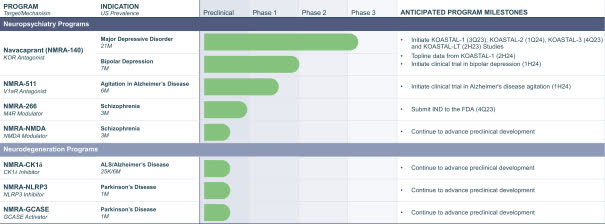
The CEO is from Wharton, and formerly was at JP Morgan M&A, and formerly served as Executive VP/ Chief Strategy Officer at AbbVie (ABBV). He played an important role in AbbVie’s acquisition of Allergan.
Financials and Valuation
Balance Sheet:
Cash reserves are expected as $324M. There is no long-term debt. Operating cash use was $120M in last 12 months, so the company is well-funded till above MDD P3 data.
Valuation:
Using an estimate of just 5% peak market share in MDD indication, I modeled peak $10B in risk-adjusted revenue in the U.S., E.U., China and Japan territories in 2032. Other inputs were:
– Average sales price of $15,600/year in the U.S., 50% of U.S. ASP in the E.U., and 25% of the U.S. ASP in China and Japan. U.S. ASP was based on prices of recently launched MDD drugs.
– Cumulative probability to reach the market = 65% (average for Phase 3).
– U.S. launch in 2027, ROW world launch in 2028. Peak global revenue in 2032.
– Launch trajectory similar to Phamagellen guide.
Using these inputs, and diluted share count of 233M, my estimate for the fair value per share is $31.
Link to the DCF Model.
I have not included bipolar depression, ALS, schizophrenia, Alzheimer’s agitation, all large target markets in the above valuation, which could add to further upside.
The mean sell-side analyst price target is $22 (range of $18-$26).
Recently, early investor Arch Ventures bought $2.2 million of the stock in late September.
Initiating coverage on the common stock with Buy rating and $31 price target (290% upside).
Catalysts
– 2H 2024: Phase 3 KOASTEL-1 data for Navacaprant in MDD.
– 2024: Phase 1 data for NMRA-511 to treat agitation in Alzheimer’s disease.
– H1 2025: Phase 2 data for Navacaprant in bipolar depression.
– 2025: Phase 3 data from Navacaprant’s KOASTEL-2 and KOASTEL-3 studies in MDD.
-2025: Phase 1 data for NMRA-266 to treat schizophrenia.
– 2025: Phase 1 data for NMRA-NMDA to treat schizophrenia.
Risks:
Risks in this investment include underwhelming data, unexpected side effects, unfavorable FDA decision, further capital raise resulting in dilution, etc., which may cause the stock price to fall.
Read the full article here