

 English
 Français
 Deutsch
 Italiano
 Português
 Русский
 Español
 简体中文
简体中文 日本語
日本語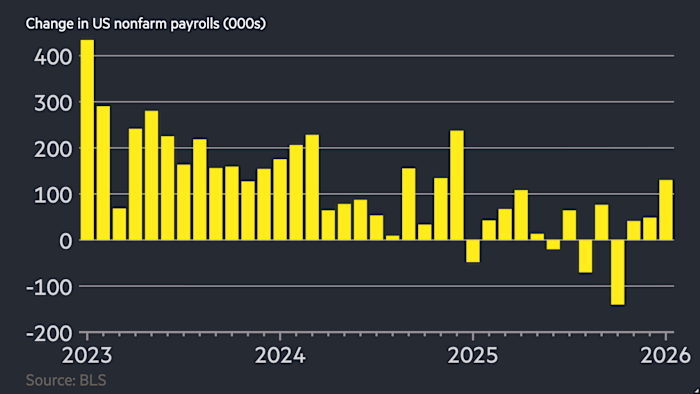

Unlock the White House Watch newsletter for free
Your guide to what Trump’s second term means for Washington, business and the world
The US economy blew past Wall Street’s expectations to add 130,000 jobs in January, signalling that the labour market is healthier than economists had feared following a number of recent gloomy reports.
Wednesday’s figure from the Bureau of Labor Statistics was almost double the 68,000 anticipated by economists polled by Bloomberg and well above the downwardly revised 48,000 added the previous month.
The unemployment rate dropped to 4.3 per cent from 4.4 per cent in December.
The unexpectedly positive start to the year took markets by surprise after recent reports showed lay-offs rising, job openings falling and unemployment claims on the rise.
“Bottom line, the January employment report showed continued improvement in the US labour market,” said Mike Reid at RBC.
The strong payroll number and lower unemployment rate “both signal that the labour market remains on solid footings despite last week’s softer labour data and recent lay-off announcements,” he said.
The data will help reinforce Federal Reserve chair Jay Powell’s argument that the labour market was showing “evidence of stabilisation” as the central bank halted its campaign of interest rate cuts last month and lessen the chances of it taking action in the near term.
“The broad-based strength in the January jobs report vindicates our view that the Fed won’t cut under Powell,” said Shruti Mishra at Bank of America.
US Treasury yields jumped as investors scaled back expectations of rate cuts this year. The two-year yield, which is particularly sensitive to monetary policy, increased as much as 0.1 percentage points to 3.55 per cent, its highest level in a week.
Traders in the futures market, who had been betting on between two or three rate reductions by December, slashed cut expectations, with just two now priced in.
“This should be welcome news for the [Federal Open Market Committee] and leave them more comfortable keeping rates on hold for a time,” said Abiel Reinhart at JPMorgan.
Donald Trump seized on Wednesday’s report, lauding “GREAT JOBS NUMBERS, FAR GREATER THAN EXPECTED!” as the president repeated calls for the Fed to slash borrowing costs. “We are again the strongest Country in the World, and should therefore be paying the LOWEST INTEREST RATE, by far,” Trump wrote on his Truth Social platform.
The positive BLS release — which was delayed after last week’s partial government shutdown — comes after data last week from employment services group Challenger, Gray & Christmas showed that US employers cut more jobs in January than any start to a year since 2009.
A separate report from payroll provider ADP pointed to sluggish hiring in January, with just 22,000 jobs added.
“The private data leading up to this had told a different story,” said Ian Lyngen, head of US rates strategy at BMO Capital Markets.
He added that the divergence between these figures and the BLS data would “likely continue to be topical as the market digests the numbers”.
As expected, the BLS also revised down job gains over the course of last year on Wednesday, from 584,000 to 181,000 on a seasonally adjusted basis, underscoring that hiring slowed sharply in 2025 after years of strong growth. The employment level for March 2025 was lowered by a seasonally adjusted 898,000 as part of the BLS’s annual re-benchmarking process.
The January job gains were led by an unexpectedly large jump in healthcare employment, while the social assistance and construction sectors also added roles. Jobs in finance and the federal government fell.
Some analysts warned against reading too much into the January figures, however, cautioning that risks to the labour market remained and that seasonal hiring could be clouding the underlying picture.
“We are not particularly optimistic about the near-term outlook for the labour market,” said Thomas Simons at Jefferies.
“The last few weeks of claims data suggests that the seasonal amplification of the labour market data is coming to an end.”
Read the full article here